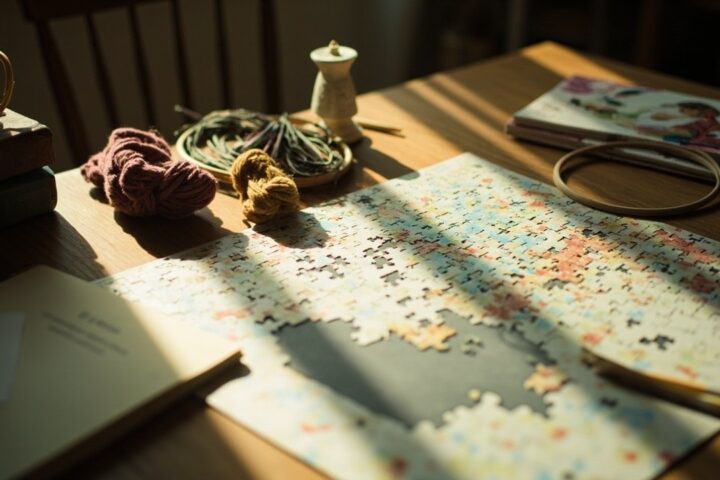
Why Quiet Hobbies Like Puzzles and Knitting Are Booming
Quiet, hands-on hobbies offer the tactile pleasure of making something while helping attention, patience, and everyday life feel more manageable.
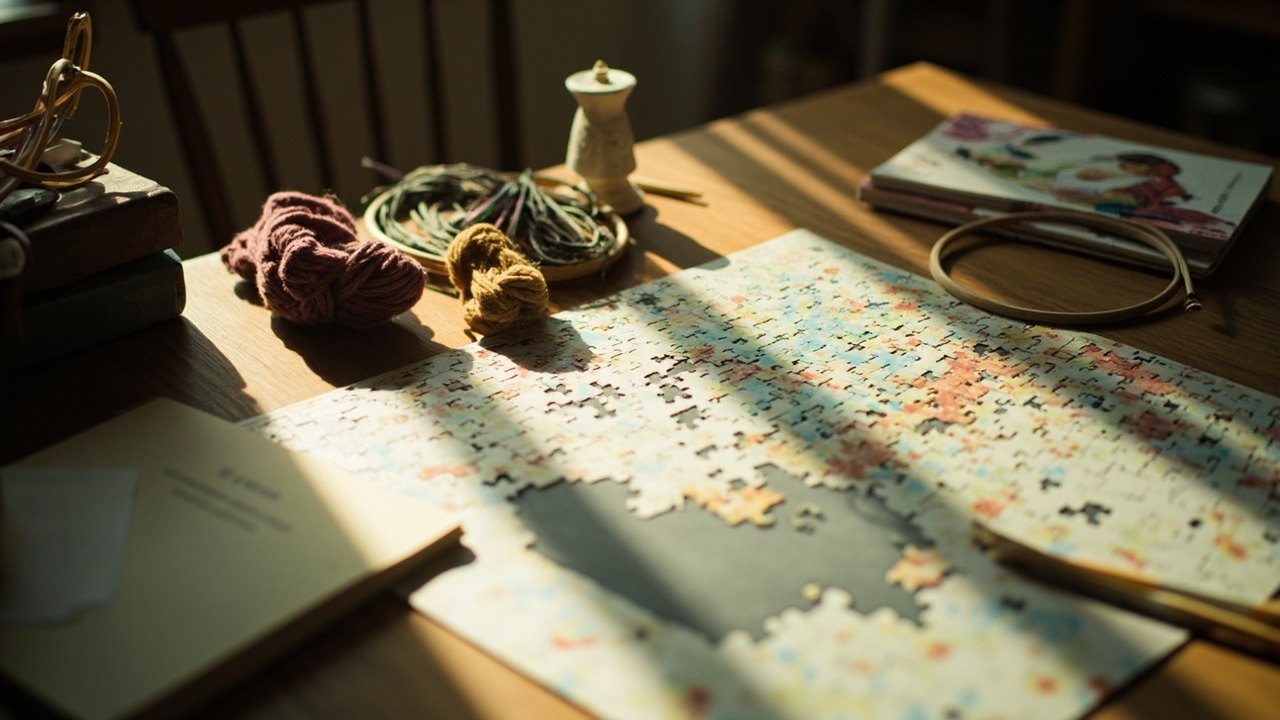
Quiet hobbies are booming because people want activities that feel absorbing, useful, and gently screen-free. Puzzles, knitting, embroidery, journaling, and model building offer a welcome contrast to constant feeds and notifications: each has a clear beginning, a satisfying middle, and a tangible result that can sit on a table, be worn, or become part of a daily routine.
The short version
- Quiet hobbies give attention a calm, specific focus.
- Hands-on projects provide visible progress and a sense of accomplishment.
- You can begin with simple supplies and adjust the hobby as your interest grows.
The Appeal of Making, Not Consuming
Many quiet hobbies share a structure that is missing from more passive forms of leisure. You gather a few materials, learn a small set of techniques, and then work through a problem. A puzzle becomes a recognizable picture. A row of knitting grows into fabric. A blank journal page fills with reflections. A collection of model parts becomes a miniature object with its own details and function.
That visible progress is part of the appeal. Even when a project takes time, it produces clues along the way: a completed section, a smooth edge, a page you do not want to tear out, or a piece that finally fits into place. These markers make patience feel worthwhile rather than frustrating.
Attention also changes shape during a hands-on hobby. Instead of moving among unrelated images every few seconds, you stay with one task long enough to notice patterns, textures, and mistakes. For some people, that feels restful. For others, it is a practical way to interrupt mental noise without adding another demand to the day.
Quiet hobbies also work well in company without requiring constant conversation. A person can knit beside a friend, share a puzzle table, or work on a model while family members do their own things. The activity creates a sense of togetherness without forcing eye contact or performance, making it useful for both solitary evenings and relaxed gatherings.
Why Puzzles Keep People Coming Back
Jigsaws are one of the easiest quiet hobbies to understand. The goal is immediately clear, and the activity can be as social or solitary as you want. The pleasure comes from sorting pieces, recognizing shapes, and gradually seeing how separate fragments form one image.
Choosing a puzzle that matches your patience helps. A large image with many similarly colored pieces may create hours of detailed work, while a design featuring distinct borders or textures can make a complex puzzle easier to navigate. Beginners can also look for puzzles with fewer pieces, larger sections, or a mix of shapes that are easier to grip.
Do not feel obligated to complete a puzzle in one sitting. Leaving a board on a table lets you return without resetting the work. A puzzle mat, shallow tray, or large flat surface can keep pieces organized and make the project easier to resume.
For people who enjoy a puzzle but dislike the pressure of a single finished picture, smaller “durable” puzzles, three-dimensional constructions, and puzzle books offer variations. The common thread remains the same: finding a satisfying route through a manageable challenge.
Knitting and Embroidery Offer Repetition and Beauty
Knitting and embroidery attract people who like the rhythm of repeated stitches and the chance to work with color, texture, or pattern. They are portable, adaptable, and easier to scale than many people expect. A simple square can become a cushion cover, a blanket, or part of a larger project, while a small stitched motif can become a card, patch, or decorative panel.
Start with one technique rather than planning an ambitious finished object. For knitting, casting on and knitting a simple row can teach the basic movement before you need to make complicated decisions. For embroidery, a backstitch, running stitch, or simple outline is enough to practice controlling the needle and thread.
Simple supplies make experimentation less intimidating. Look for yarn in a weight you can handle comfortably, fabric with an even weave, and a needle size suited to the material. Leftover yarn, remnants, inherited sewing boxes, and thrifted supplies can all become practice materials rather than items you feel guilty about wasting.
Learning to read a pattern may take a little patience, but the skill grows quickly. Many knitters keep a project notebook with stitch notes and corrections. Many embroiderers photograph finished motifs or mark the fabric before stitching. These small habits make mistakes feel like useful information rather than evidence that you are bad at the craft.
Journaling Makes Room for Private Thinking
Journaling is quiet, flexible, and surprisingly easy to personalize. It can be a detailed record of the day, a place to plan, a place to work through a decision, or a few lines written before bed. Because the format is open-ended, there is no single correct way to begin.
A simple notebook and a pen are enough. Some people write in complete paragraphs; others use lists, sketches, or questions. A daily page might ask what went well and what needs attention tomorrow. A weekly entry could gather observations, meals, books, places visited, and ideas worth remembering later.
Keep the routine small if consistency is the goal. Five minutes on most days can become more useful than an elaborate system abandoned after a busy week. Leave the notebook where writing is natural, such as beside the bed or near a frequently used table, and use whatever prompts help you start.
Journaling also benefits from imperfection. Messy pages, crossed-out sentences, and changing interests are part of the record rather than flaws to correct. Over time, the pages can become a personal reference that helps you notice patterns in your mood, priorities, and relationships.
Model Building Combines Focus and Careful Craft
Model building offers the satisfaction of turning many small parts into something precise and displayable. Depending on the interest, the result might be a miniature structure, vehicle, character, machine, or architectural model. The process rewards patience because accuracy often depends on small decisions made slowly.
Beginners can learn by choosing a project with clear instructions and manageable assembly. Read through the full guide before opening the parts, identify the main stages, and note any tools or materials that are not included. A cutting mat, tweezers, a hobby knife used with care, and a small brush can be useful additions, but simple projects may need little beyond the kit and a steady surface.
Painting can begin after the major assembly is complete. Thin coats often produce a more even finish than heavy layers, and practicing color combinations on an extra piece can reduce anxiety. If painting does not interest you, an unfinished build can still provide the tactile and focused experience the hobby promises.
Displaying the finished model gives the project a clear endpoint. Keeping it on a shelf or in a glass cabinet lets you appreciate the details you spent time creating and may encourage the next project.
How to Start Without Buying a Full Set
The easiest way to begin is to reduce the first session to one manageable action. For a puzzle, spread out a small section. For knitting, practice casting on and working a row. For embroidery, stitch a simple line across scrap fabric. For journaling, write three prompts. For a model, sort the parts and complete the first labeled stage.
Borrowing can also lower the barrier. Ask a friend or relative to lend supplies, visit a library that lends craft materials, or look for classes where basic tools are shared. Community craft groups and hobby meetups offer both instruction and encouragement, but a quiet evening alone is just as valid a way to start.
Choose a project you would be willing to revisit rather than one that merely looks impressive online. Keep materials visible, set aside a regular short session, and finish one stage before adding a new one. Motivation often follows visible progress more reliably than enthusiasm alone.
Give a new hobby a few weeks before judging it. Your hands need time to learn unfamiliar movements, and your attention needs time to settle into the new rhythm. The goal is not to become especially skilled at once. It is to find an activity that makes the next quiet moment feel more engaging.
Frequently asked questions
Do quiet hobbies really help with stress?
They can provide a calm break from constant mental stimulation, but the effect depends on the person and the activity. Repetitive, predictable tasks may feel soothing, while a difficult puzzle can be demanding if you are already tired. Choose a level of challenge that feels engaging rather than overwhelming.
Which quiet hobby is easiest for a complete beginner?
Jigsaws and basic journaling are usually straightforward because the instructions are intuitive and the commitment is flexible. Knitting, embroidery, and model building also have manageable first steps if you begin with a simple project. The best choice is one that interests you enough to try again.
How do quiet hobbies fit into a busy schedule?
Short, regular sessions work well for people with limited free time. Even ten minutes can advance a puzzle, complete a row, write a page, or work through one assembly stage. Keeping a project easy to resume is more helpful than waiting for a large block of uninterrupted time.
Quiet hobbies are not escapes from ordinary life so much as small ways to participate in it more attentively. Whether you fit pieces together, loop yarn over a needle, stitch a pattern, write a page, or assemble a miniature, the reward is the same: your hands are busy, your attention has somewhere to land, and something tangible reflects the time you gave it.